
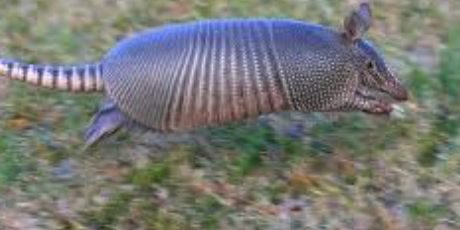
If a Scorpion Hugged an Armadillo, would it contract Leprosy?

Of all the infectious diseases in history, one that has gotten an unwarranted bad rap is leprosy, or Hansen's Disease. This disease, which is mentioned in the bible, has become synonymous with contagion--but it's not really a very contagious disease at all. 

Hansen's Disease, caused by infection with Mycobacterium leprae (and also M.lepromatosis), is a chronic disease that effects the respiratory system nerves, skin, and mucus membranes. It is by no means incurable as it is amenable to treatment with antibiotics. It is spread from person-to-person via the respiratory route. It's natural host is the armadillo. In 2009, a little over 200 new cases were reported in the US.

What most people don't realize however, is that 95% of humans are unable to be infected because of a specific genetic resistance conferred via their immune systems.  This means that far from being highly contagious, leprosy's transmissibility between humans is seriously hobbled. 

All of these facts have been known for sometime but it didn't stop the creation of leper colonies (e.g. Molokai in Hawaii) or other unjustified control measures in the not too far past. These misconceptions persist to this day and have penetrated deeply into popular culture. Case in point: the television program Scorpion. On a recent episode, one character states to another that he hugs as if he's at a leper colony. Such a comment is based on an extremely erroneous notion of leprosy's contagiousness.

What this brief mention on a tv program illustrates is the need to educate people on the difference between highly contagious infectious diseases and those that are less contagious. Such a point was something that I sought to make, over and over, with Ebola lest unjustified control measures be instituted as they were with leprosy. 

When Uncle Sam Battled Malaria

It is said that half of all humans who have ever lived died from one cause: malaria. It's hard to imagine any disease having a toll like that. However, the prowess of malaria is something that has modified human behavior--and indeed genes--for a very long time. 

A book I just finished tells the remarkable story of how the WWII-era US military engaged in all out war against this microbe that had a real potential to derail the war effort. Johns Hopkins University lecturer Karen Masterson expertly details the extensive history of these efforts in The Malaria Project: The U.S. Government's Secret Mission to Find a Miracle Cure.

The book reads almost like an adventure story chock full of memorable characters that range from revered generals and scientists to sociopathic murderers as well as Dr. Suess. The events take place on almost every continent and tell the story of how all our modern anti-malarials came to fruition while also addressing important issues such as experimentation on prisoners. The book also concretizes why, even to this day, the military has such a strong interest in infectious diseases--in a phrase: force protection.

The sheer amount of material that Ms. Masterson must have had to find and analyze in order to produce this exciting and highly educational narrative must have been daunting. The benefit one gets from reading the book, by comparison, is a bargain because of her diligent work.


Lindsay Lohan Battled Mean Girls, Now a Mean Virus

When a celebrity contracts an infectious disease it's kind of a mixed blessing. On one hand, awareness of the illness skyrockets but on the other it's kind of frustrating that the media pays much attention only when a celebrity contracts the illness.

Such is the case with Lindsay Lohan's recent bout with chikungunya which has caused millions of cases in the Caribbean, hundreds of importations to the continental US, and even caused mosquito pools in Florida and Texas to become infected with the virus. In Florida, 11 cases of local transmission have occurred from infected mosquito pools. 

Since there is no antiviral or vaccine for chikungunya, the chief means of combating this disease, which can cause debilitating joint and muscle pains, is to avoid being bitten by the Aedes mosquitoes that harbor the virus. Easier said then done, however, as people who frolic in the Caribbean don't have a habit of donning clothes that cover their bodies or wearing mosquito repellent consistently. What does work, however, is to reduce the breeding sites of the mosquitoes by removing standing water and receptacles (e.g. bird baths, tires, etc.) that collect water.

It's clear that Ms. Lohan's infection and her public statements on her illness will focus more attention on this disease and that is unequivocally a good thing. 

Plus, we know the Mean Girls were no match for her and, hopefully, this mean virus will succumb as well. 


A Rock Band that Battles HPV

This evening I attended a remarkable event sponsored by the Pittsburgh Jewish Healthcare Foundation and HPV Pittsburgh at Magee Women's Hospital of UPMC. The event included a screening of an interesting documentary film titled N.E.D. (No Evidence of Disease) which chronicles the rock band of the same name whose members are all gynecologic oncologists whose focus is on raising awareness of the cancers they expertly treat. 

Among those cancers several (cervical, vulvar, and vaginal) are the result of infection with the human papilloma virus (HPV). What is special about this cancer-causing virus is that highly efficacious vaccines have been developed to combat it.

Despite the availability of these life-saving vaccines since 2006, only about 57% of adolescent females and 35% of adolescent males have received one or more doses of these vaccines. As HPV is virtually the exclusive cause of cervical, vaginal, vulvar, anal, and penile cancer as well as significant proportion of head & neck cancers these vaccines--which now include a 9-valent version--have the potential to alter the cancer landscape by eradicating many cancers (and genital warts as well). 

As an infectious disease physician, I relish treating infectious diseases, however I don't bemoan the patients I never see because of vaccines. It is an unequivocally better state.

Is Lariam Malaria's Revenge?

The antimalarial compound mefloquine (also known by its former brand name) Lariam is a mainstay of malaria prophylaxis. First developed in the 1970's by the US Military, to whom malaria has historically inflicted a countless amount of suffering, it has risen to such wide use that it is one of the drugs included on the WHO's Essential Medication List. 

The advantage of mefloquine, in an era of malaria-drug resistance, was that it could be used as a preventative prophylactic in many malarious regions of the world (with parts of, for example Vietnam and Laos excepted). 

All medications have side effects, however one of mefloquine's is becoming so notorious that it was used as a plot device on ABC's Revenge (Lariam is not a character's name, though it would be a good one). The side effect in questions are neuropsychiatric in nature and include hallucinations and bizarre behavior. Milder side effects such as vivid dreams occur in 25% of those taking the medication. In the show mefloquine was employed as a surreptitious means of causing a character to appear mentally ill. 

These side effects are very real and have even had ramifications in the military's trial of Staff Sergeant Robert Barnes, convicted of killing 17 unarmed Afghanis. Barnes had no rationale to offer for his behavior and he had been on mefloquine in the past.  

While I believe it not likely that a medication can induce someone to commit such an act. Psychiatric disturbances induced by the drug, in the presence of severe underlying neurologic or psychiatric disorders, may exacerbate homicidal or paranoid thoughts to extreme levels. 

In today's legal environment, it will not be surprising when mefloquine use is cited as a mitigating factor in a legal proceeding. Fortunately, there are, in most cases, alternatives that can be used and the military has moved away from using mefloquine as its first line antimalarial. Additionally, more general usage has fallen off steeply since the FDA issued a black box warning regarding these side effects, which in some cases are permanent. 

But, the importance of antimalarial prophylaxis can not be understated. Malaria is a killer and in 2011 the US reached a 40 year high of malaria importations when nearly 2,000 cases were reported. In 2012, approximately 1600 imported cases occurred with 6 deaths; ominously only 6% (!!) of individuals reported adherence to a recommended anti-malarial regimen. 

Though mefloquine has serious side effects, the role of other anti-malarials is very important and non-compliance is a sure way to contract this dread disease.