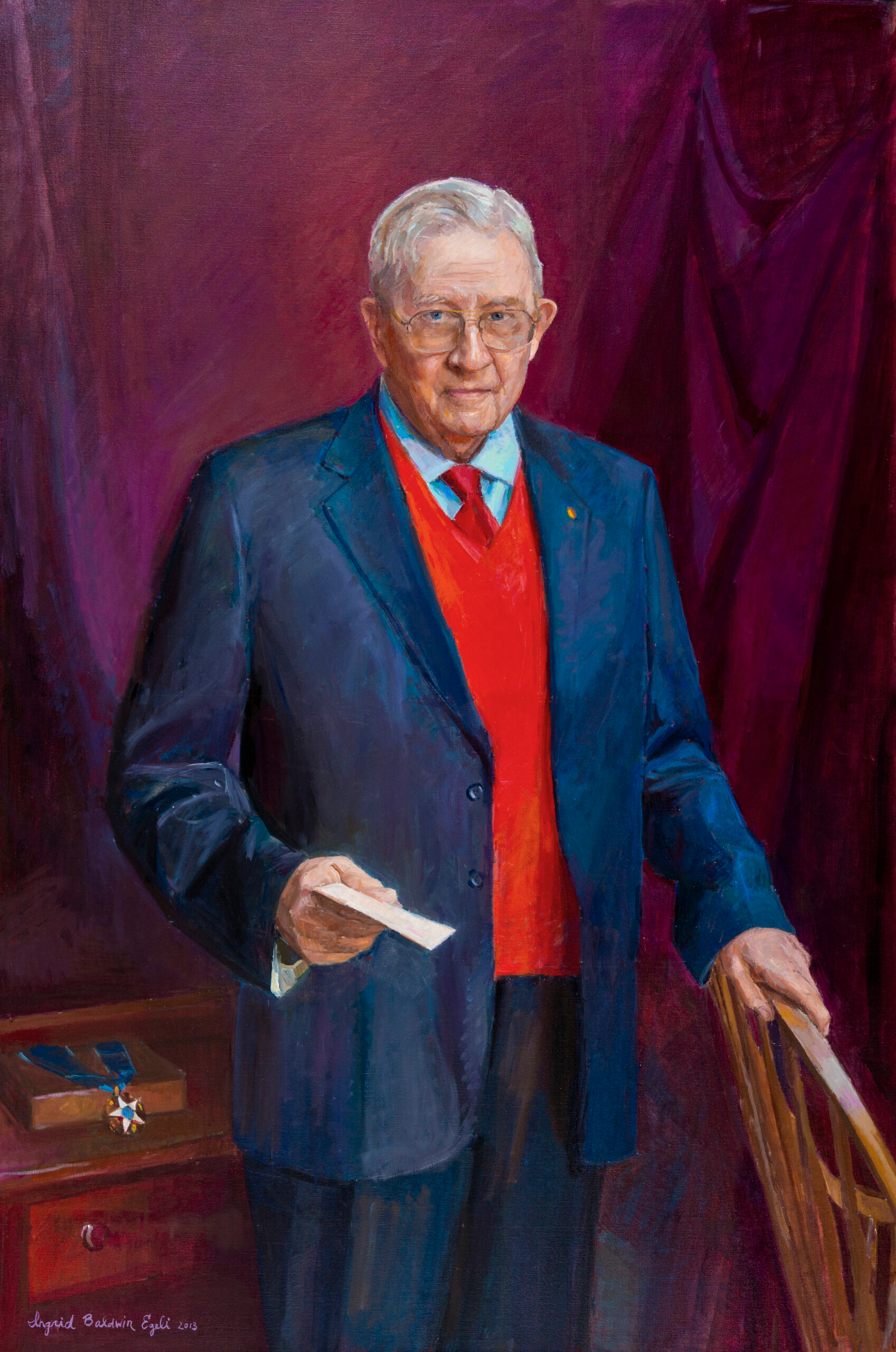
A decade of asking questions nobody has answered
Ten years ago today, D.A. Henderson died. I have written to him every year since — a list of questions I would have walked down the hall to ask him if he were still in his office. His absence is a standing deficit, a chair at the table nobody has filled. Ten years of these letters has produced a ledger, and this year's ledger is worse than last year's, which was worse than the year before that.
Here is some of what I would ask him.
Ebola Unchained
DRC declared its seventeenth Ebola outbreak on May 15, in Ituri Province, not long after the previous one ended. The virus is Bundibugyo, not Zaire, and there is no licensed vaccine and no approved treatment for it. It is the deadliest outbreak in DRC's history, the fastest-spreading ever recorded, and second in the world only to West Africa in 2014–16 which it is projected to eclipse. Most cases emanate from unknown chains of transmission, most deaths (which number over 2300) occur outside Ebola treatment units, and the population has not accepted the need for safe burial practices and other standard public health interventions. There has been real consideration of the idea of this area of the DRC becoming endemic with Ebola — a frontier of Ebola necessitating neighboring areas remaining eternally vigilant.
During the largest Ebola outbreak in 2014 you and I once argued that the fastest way to stop an outbreak like this is to concentrate everything on the small number of people doing most of the transmitting rather than chasing every contact evenly.
How would you do that in this context? Use the Merck Zaire strain vaccine — which has some anecdotal evidence of cross protection against Bundibugyo — in rings? What are the top three things you think need to be done to gain some semblance of control of the outbreak? What is the realistic time frame for control (1 year, 2 years)? How was neighboring Uganda able to act so decisively and delimit their 20 cases?
The soda-bottle EO
On August 10, President Trump signed an executive order instructing HHS to develop separate single-disease measles, mumps, and rubella shots, on the theory that giving three diseases' worth of vaccine at once is somehow excessive — he has compared it to pouring a bottle of soda into a child's body. The order also cuts the vaccines recommended for every child from seventeen down to eleven, shifting the rest into a vaguer shared-clinical-decision-making category. I’m glad you didn’t have to watch it.
You ran the campaign that made a human disease disappear from the planet with one shot (or scrape) per arm aimed at getting a single dose into as many arms as possible. Your method was to subtract complexity, not manufacture it.. You had no patience for controversies invented to solve problems that did not exist.
I imagine the clarity and authority of your booming voice on 60 Minutes dismantling the disinformation apparatus of RFK Jr. and his minions, reassuring the public (as you did all of us during the anthrax attacks), championing the value of vaccinations and the legacy of Jenner (which you completed). I think these minuscule gnats would shrivel just at the sight of you.
The US has confirmed 2,566 measles cases this year, the worst count in decades, and PAHO will review whether the country keeps its elimination status in November. You thought measles was a harder eradication target than smallpox, precisely because it spreads faster and more quietly, and you were skeptical of global measles eradication for that reason — but you lived to see the Americas declared measles-free in 2000 and treated it as a real accomplishment worth defending.
What do we do now? Measles is on a trajectory to become endemic in the US again and a resource consuming public health and healthcare system problem. Once our designation is gone, is there a version of elimination worth the fight to reclaim, or was 2000 a one-time achievement that doesn't come back around twice?
The platform works, the institution doesn't
The FDA approved mFlusiva on August 5 for adults fifty and older — an mRNA influenza vaccine roughly 27% more effective than the standard shot — six months after the same agency refused to review it and then reversed course. But ACIP has issued no recommendation for it. ACIP itself is littered with RFK Jr.’s acolytes and is non-functional. You judged a countermeasure by whether it worked, full stop — never by which political tribe had claimed it as a mascot.
What do you make of a government that approved the best flu vaccine in decades and embedded it in a maze that keeps it out of people's arms? How do we keep the promise of mRNA technology — so critical for pandemic preparedness against avian influenza — alive in this toxic disinformation-laden environment?
Medications favored over vaccines
Xocova was approved as the first oral pill to prevent COVID after exposure, cutting symptomatic infection by 67% when started within 72 hours of contact. DoxyPEP — a dose of doxycycline after sex to prevent bacterial STIs — is now becoming standard of care even as it consumes its own advantage: surveillance in San Francisco and King County already shows gonococcal tetracycline resistance climbing in step with doxyPEP use, and models project meaningful loss of efficacy within five to twelve years even at modest uptake. HIV PrEP, with the addition of lenacapavir, is revolutionary. Nirsevimab, the preventive antibody against RSV in infants, is changing the face of pediatric RSV while pemivibart protects the most immunocompromised against COVID-19.
I remember sitting with you in briefings about the potential smallpox antiviral tecovirimat and seeing your steadfast loyalty to the vaccine — the tool you used to beat the virus back and foreclose its ability to ever harm humans again.
Now all these medications are all genuine advances that provide valuable (or in the case of HIV PrEP, incalculably valuable) additions to the armamentarium. But, keeping on the theme of my questions, I wonder if some of them are being conceptualized not as tandem products to vaccines but as vaccine substitutes. For example, the head of HHS ARPA-H said: “There's actually a multitude of other technologies that you can use to protect people against infectious disease.” That seems to me to be coded language against vaccine technology.
So, how do we balance drug-based prevention with vaccination, knowing that there is more than a hint of irrational anti-vaccine sentiment partially driving it?
***
Better tools, weaker resolve
Every question I posed DA above has the same shape. Mastering infectious disease is no longer an exclusively scientific, technological, or medical problem. What we have is an implementation problem driven by a larger philosophical one: the return of the primitive in the form of Dark Ages’ mentalities that are openly advocating for a lower standard of living, for civilization to march backward.
DA spent his career on the inverse problem — a bifurcated needle, a jet injector, an index card, and institutions with enough authority and credibility to make those crude tools work anyway. I would love to know what he could do with the technologies we have today.
Ten years of asking DA these questions hasn't made the exercise less useful. It has made it more damning of us. I believe DA would have found this year infuriating rather than tragic. Infuriating things can still be fixed but the task is inestimably harder with his chair still empty.
I do not believe that our cause is finally lost, because it is based on truth, reality, logic and reason with an aim to improve individual human lives. But I wish DA were here to tell me how he would win because I know the nihilist forces we face would be no match for him mantled with the prowess of Jenner and Pasteur.