Putting Zika Virus into Context

Now that a case of Zika virus was recently confirmed in one of the 50 states (Texas), I expect a lot of domestic media attention to be focused on this virus that heretofore was not considered a major public health threat. Indeed only 1 in 5 people infected with this mosquito-borne virus actually experience symptoms.

What changed the perception? The correlation of its appearance in Brazil and the increase in fetal microcephaly cases, which number in the thousands. Fetal microcephaly refers to an abnormally small-sized head on a developing fetus. This condition has myriad causes and Zika virus has not been definitively proven to be an etiologic agent in any of the cases -- though the data is very suggestive. Microcephaly is a devastating diagnosis that can lead to abnormal brain functioning and a shortened lifespan. Thus far just 3 deaths of been reported, including one microcephalic newborn who died within 5 minutes of life. There are 2 deaths in El Salvador from the autoimmune neurologic disorder Guillan-Barre-- a rare complication of Zika and many other infections -- being investigated for possible linkages to Zika (something also being investigated in Brazil).

What is most significant, to me, about Zika virus is that it is spread by Aedes mosquito which also serve as the vector for the much more dangerous dengue and chikunguna viruses that are relatively neglected and haven't claimed international headlines as forcefully as the benign-in almost-cases Zika has (the subject of a blog post by another infectious disease physician). Societal has little tolerance for infections that target developing fetuses (witness the rubella elimination campaigns) even if they do not incur much damage to adult hosts. (Inappropriate aside that I can't resist -- Beetlejuice didn't like his own microcephaly either). 

With the attention on Zika however, there should be a renewed push to optimize Aedes mosquito vector control -- which should include the use of GMO Aedes mosquitoes to decrease population sizes -- as well as draw attention to the GSK Dengue vaccine (approved in Brazil, Mexico, and the Philippines -- but not yet the US). 

One last thing, though this Texas Zika case may capture headlines, Zika has been here before (confirmed cases and likely undiagnosed mild cases that escaped notice). What remains to be seen is if this virus will be successful like its forebears dengue and chikungunya in setting up foci of autochthonous transmission within the United States.

Salmonella, Swollen Glands, and other Cool Stuff

When someone is sick with an infection they often experience swelling of their lymph nodes, or lymphadenopathy. This is colloquially referred to as having "swollen glands" and is usually apparent in the neck region. What is going on when this phenomenon occurs is that immune cells are basically congregating in the lymph nodes and undergoing something akin to a pep rally before they face the invader. These conglomerations occur at sites known as follicles in which germinal centers are formed. The result of this process is an army of elite soldiers armed to the teeth with antibodies exquisitely targeted to the microbe that set off the immune system alarms. When your "glands" feel sore it's basically because the equivalent of troop mobilization is occurring. This massive oversimplification is the standard text book version of the events.

I recently listened to a fascinating lecture by Pitt's immunology chairman, Dr. Mark Shlomchik on this topic -- specifically when it doesn't occur quite as is written in the textbook. The infection that his research group has described an alternate pathway of immune response for is Salmonella. Salmonella is a major infectious disease threat that is responsible for thousands of cases of foodborne illness yearly. One of the intriguing facets of Salmonella is that it can, in certain contexts, turn humans into carriers who chronically shed the bacteria (this is well known with the typhoid species of Salmonella but can occur with the gastroenteritis causing members of the group as well).

The papers describing this work (in mice) conducted by Shlomchik and other groups are quite technical, but really really neat. Here's my attempt to drill it down to the basics:

It had been known that Salmonella infections produce what is known as an extrafollicular immune response with germinal center formation delayed by one month. This response produces antibodies that are directed against Salmonella. These antibodies are specific to Salmonella but are not the sharpest tools and have a lower affinity than a full-fledged graduate of the germinal center.  

Another interesting event that occurs is the germinal centers form only when the bacterial load falls through progression of the infection or via antibiotic therapy.

What could be the purpose of this alternative pathway? What is the evolutionary driver here?

A couple of hypotheses: if Salmonella "wants" to have us as its carriers it has to do two things: 1) not kill us and 2) not be killed by us. Could the suppression of germinal centers -- keeping the immune system's schools closed -- be a way to accomplish that by prompting a less elite team of the immune system to respond? This 2nd string team could keep the bacteria out of the bloodstream and somewhat in check (but not completely).

So cool.

Is that Something in the Air Bipolaris?

Snip20160108_13.png

In 2013, prompted by infections in 2 Texas patients, the CDC was asked to investigate mysterious cases of a rare mold infection known as Bipolaris in cardiac surgery patients. The results of that investigation were recently published in Medical Mycology and contain some interesting findings. 

Bipolaris is a rare fungus that is not a well-characterized cause of surgical infection and is considered a rare infectious agent, preying on the immunosuppressed as most organisms like this do. Brain abscesses and subcutaneous skin infections are two types of infection Bipolaris is known to cause. Bipolaris infections are known as phaeohyphomycosis because of their pigmented cell walls ("black mold").

Prompted by the initial 2 cases and concern for a possibly contaminated medical product, the CDC conducted an expanded investigation and uncovered a total of 23 cases of Bipolaris infection that occurred in Texas, Arkansas, and Florida between 2008-2013.

Some important points about the cases included:

  • Median age of 55
  • 1/3 were heart transplant patients
  • 52% were receiving immunosuppressant medications
  • Delayed sternal closure in the majority of patients
  • Median days of having an open chest was 8 days
  • 40% had an emergency bed-side procedure for bleeding
  • 76% of patients died

The CDC discusses what may have been behind some of these infections and hypothesizes that procedures performed in rooms without positive pressure to the environment, in which ubiquitous environmental mold spores could enter and find their way to an open chest, may have played a role. 

In the discussion section of the paper the authors mention that no formal surveillance for invasive mold infections of this sort is performed. It seems to me that the Bipolaris outbreak and the elucidation of risk factors are important benefits that will accrue from such surveillance. As common-source outbreaks involving mold may be less common than their bacterial counterparts, it is minimizing and mitigating known risks that takes on greater importance.

The World Perished in Pandemic (the board game)

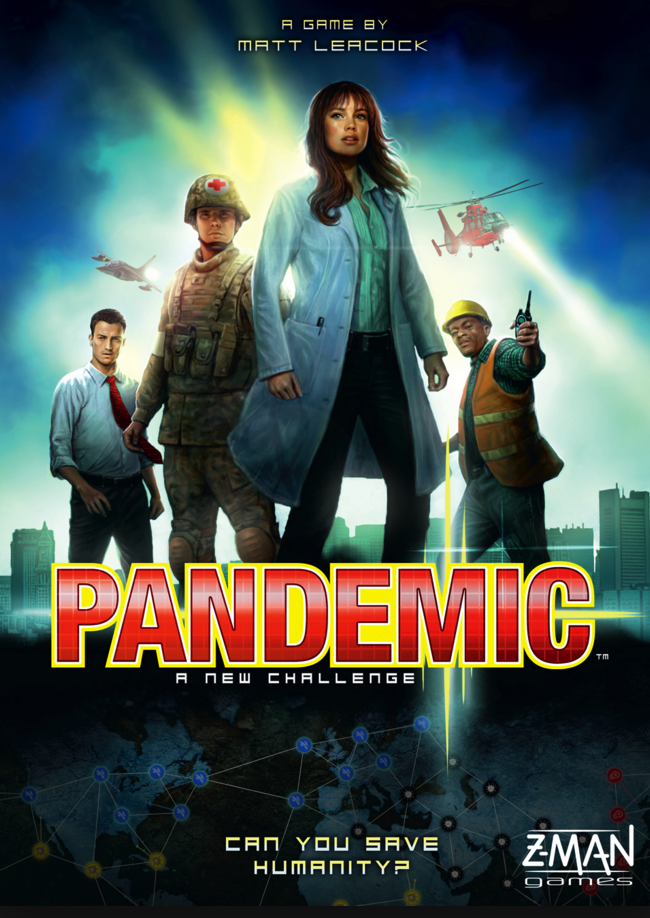
A couple of months ago I purchased the board game Pandemic (designed by Matt Leacock) for obvious reasons. I got around to trying my hand it at last night and found it to be fun, challenging, and surprisingly reality-based. 

This award-winning board game pits the players versus 4 different pathogens that are dispersed around the globe and all poised to cause outbreaks. The game involves strategic decisions and trade offs such as building research facilities, working towards cures, and treating disease. Each player has a special unique role with special features -- I was a dispatcher while my friend,  newly minted PhD, was fittingly a scientist.

For my first time playing, I set the game to the lowest difficulty level and still ended up consuming by chain reaction outbreaks that I was powerless to stop.

Needless to say, I think the game was well worth the price and fun to play. I hope that the legions that play the game get an inkling of the real non-board game challenges the world faces with infectious disease outbreak and maybe a small fraction, like those still obsessed with Candyland, will be inspired to pursue infectious disease as a career.

The Chimp and The River: The Origin Story of HIV

When I think of the prototypical infectious disease -- the one that illustrates everything perfectly and makes all the "right" moves -- HIV is what always comes to mind. This prolific killer emerged and sparked a pandemic that killed 40 million humans to date. Like any good serial killer, the origin story is important and fascinating not just because it gives us a morbid pleasure to see the first forays the virus made into killing but it underscores the essentials of how any emerging infectious disease establishes itself, transitioning from epidemic to endemic.

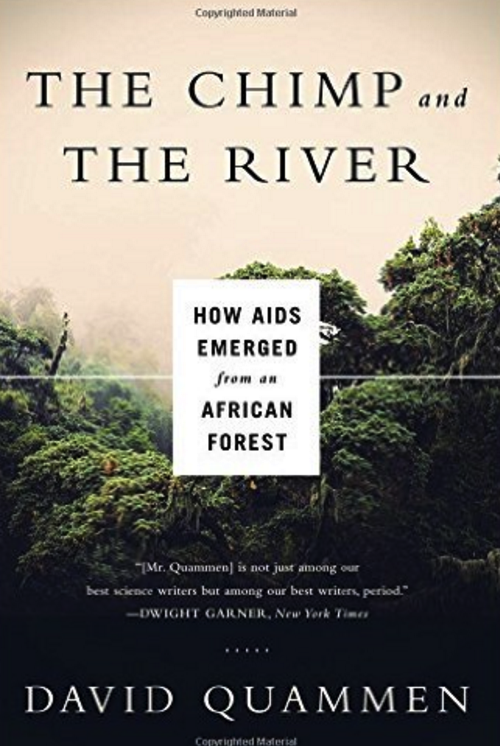
I have read many book on different facets of HIV and, for the most part, have found value in all of them. The latest HIV book I read, The Chimp and The River: How AIDS Emerged from an African Forest by David Quammen, wasn't a "new" book in the strict sense but an adaptation of a part of his earlier must-read book Spillover. Though the material in this book wasn't new to me, its stand alone presentation did something to make it much more real to me -- or it could be just be the benefits of a good 2nd reading.

The book's aim is to focus on just one aspect of HIV: how, when, where, and why it spilled into humans. Quammen's ability to tell an Indiana Jones-style detective adventure story is completely captivating to me and, even though I know where the story is going to lead from familiarity with the scientific research, his version is much better than the often dry scientific papers I read.

Integrating the cut-hunter hypothesis for HIV's initial spillovers into humans (and before that spillovers from monkeys to chimpanzees) with the trajectory of the global pandemic is a tough task that is expertly executed in this short book. Many important facts such as how many times HIV has spilled-over into humans (about a dozen, one for each strain of HIV-1 and HIV-2), the 2 monkey species chimerism of the HIV-1 progenitor SIVcpz, and the wedge of Cameroon where it all began are covered with great and memorable detail.

I highly recommend this book and hope that as the HIV story continues to unravel, Quammen's expert narrative of the phenomen will continue as well.