Rat Lungworm Backwash: Why Slugs are Not the Best Drinking Partners

One of the latest obscure and tantalizing infectious diseases to garner sensationalistic headlines is "rat lungworm disease" in Hawaii.

This infection, caused by the roundworm Angiostrongylus cantonesis, is not a very common entity in the US though outbreaks and sporadic infections occur worldwide. In its natural infective cycle, this worm is ingested by rats via mollusk intermediaries such as snails, prawns, and slugs. The larvae migrate through the vasculature to the lungs and to the brain. Adult parasites live in the lung and lay eggs which, after hatching, are coughed up, swallowed, and passed into the feces to find a mollusk host and the cycle repeats. 

When humans get caught up in the cycle after, for example, ingesting an uncooked snail or a salad contaminated by larvae the result is eosinophilic meningitis arising from larval migration to the brain. This condition is usually just a mild illness but can lead to coma and death with massive infections. Fever, nausea, vomiting, and neck stiffness are common symptoms. It is diagnosed clinically and through spinal tap where a larvae may be spotted in the cerebrospinal fluid. Treatment is usually with steroids. 

This year 11 cases have been reported on two of Hawaii's islands and represents an increase over the expected number of cases which usually number about this many for the entire year. Speculation is that an influx of semislugs on Maui may be responsible for this increase as at least 2 cases arose from a homemade kava elixir which they shared with slugs. 

I suspect that this outbreak will be contained once public awareness rises and people are more careful of their exposure to foods that might harbor the parasite and take appropriate action like cooking it, washing it, and discarding it if slugs have decided to have a bite or drink too. 

A general rule of thumb, however, is not to share straws with a slug.

Kiss A Frog, Fight the Flu

There is always speculation about particular compounds that exist naturally in the wild that may have benefits for human health. Indeed, history is full of stories like this from quinine to aspirin. New research from Emory shows that frog mucus contains a potentially flu-fighting antimicrobial peptide. 

For the study peptides contained in the mucus from Hydrophylax bahuvistara frogs were screening for both anti-influenza activity and non-toxicity to human cells. Of these screens, one peptide, named urumin, emerged as the leading candidate. Urumin was noted to interact directly with the influenza virus at an important site: the conserved stalk area of the H1 hemagglutinin. Because it is a "conserved" region (i.e. one not highly mutable) the frog peptide retained activity against drug-resistant variants. This region is one of the targets of the long sought after universal flu vaccine. In the study, urumin worked not only in vitro but also in a mouse model.  The peptide was specific for just H1 variant influenza A viruses.

I found the paper to be very interesting and the discoveries may have wide-ranging implications not only for novel antivirals but for understanding influenza. As the authors note, innate defense mechanisms are less likely to be prone to resistance because they presumably were selected  via natural selection for their durability against their target. It is unclear what role amphibians have with influenza A epidemiology but it appears they can be infected and perhaps urumin is one of its natural defenses against the virus. Future studies with ferrets will be important to perform as they are important surrogates for humans.

Clinical Care Gaps in US Zika Cases

Today, the CDC released important new information on the Zika outbreak and its impact on pregnant women. The report, which details approximately 1300 US pregnancies, contains several important points:

  • The risk for fetal malformation is the highest in the 1st trimester with 15% of confirmed 1st trimester infections having this horrific result
  • Overall, the risk of fetal malformation appears to be 10% with confirmed maternal infection
  • The vast majority of babies with possible Zika infection or brain malformation did not get further testing (either for diagnosis or brain imaging)

This last point is the most ominous as it shows just how hard it is for crucial public health and medical messaging to find its way to the front line clinicians. Diffusion of knowledge in ordinary care is a difficult decade long process -- clearly not something that can be tolerated in the midst of an infectious disease emergency like Zika. 

Winning Isn't Everything: A Review of Have Bacteria Won?

I recently finished the next infectious disease book on my long list -- I think I've been reading these books non-stop since 1996 and probably will forever -- University of Aberdeen microbiology Professor Hugh Pennington's Have Bacteria Won? 

This short book, part of the New Human Frontiers series, was published in 2016 and is packed with a lot of good information and narrative from an expert in the field. Being written by a UK expert is a large value to the American reader as it is recounts many UK-based infectious disease outbreaks that may not be so familiar but nonetheless contain important lessons. 

His introductory chapter is entitled "Why We Are so Worried About Bacteria" and provides an overview of some headline-grabbing infectious diseases. The most popularized UK-based outbreak (which is non-bacterial in origin), of course, is bovine spongiform encephalopathy (BSE, Mad Cow Disease) and its human form, vCJD, which Dr. Pennington details noting that no new human cases have been diagnosed in those born after 1989. In addition to BSE, the chapter highlights other important infectious diseases such as necrotizing fasciitis (flesh-eating bacteria)  that, despite media attention, has been known to medicine since at least 1924.

In the chapter's treatment of Ebola, Dr. Pennington includes a very revealing and interesting quote from the court proceedings against heroic nurse Kaci Hicox who was forcibly -- and unjustifiably-- detained by government agents:

“the court is fully aware of the misconceptions, misinformation, bad science and bad information being spread from shore to shore in our country with respect to Ebola. The Court is fully aware that people are acting out of fear and that this fear is not entirely rational. However, whether that fear is rational or not, it is present and it is real Respondent's actions at this point, as a health care professional, need to demonstrate her full understanding of human nature and the real fear that exists. She should guide herself accordingly.”

The quote, from a Maine judge, shows just how far we've fallen that despite acknowledging the irrationality of the mob in their fear of Ebola the judge still advises Hicox to placate it!

Other aspects I particularly concepts that I found particularly notable included: "sewer socialism", a defense of pasteurization (unpasteurized products have a 150-fold increased risk of being involved in outbreaks), the significance of mutant broiler chickens, "allowable" Salmonella levels in chocolate, the "trans-science" of influenza prediction, and Paul Ehrlich's work with pneumococcus and the quinine-derivative optochin in 1911 and its fate foretelling the modern antibiotic resistance crisis which he deems not a scientific problem but an anthropological one.

Have bacteria won? We know Pasteur said microbes would have the last word but reading Dr. Pennington's words is nonetheless highly recommended.

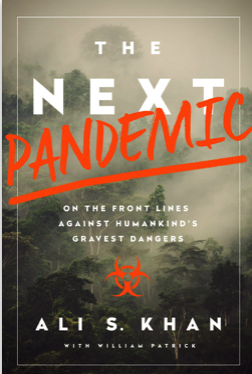
An Expert Play-by-Play of Emerging Infectious Disease: A Review of The Next Pandemic

In order to have an understanding of the field of emerging infectious disease and be able to make some sense of the daily vicissitudes of outbreaks, odd cases, and long-standing endemic infections one has to have some sense of the context and history of the field. Having a first person tour guide would be indispensable. That is the role that former CDC official, and now University of Nebraska Medical Center College of Public Health dean, Dr. Ali Khan, plays in his book The Next Pandemic: On the Front Lines Against Humankind's Gravest Dangers

Drawing on a wealth of on-the-ground experience Dr. Khan uses carefully selected cases to illustrate several key concepts that are fundamental to the field. Though the incidents described in each of the chapters were all very familiar to me, they still held a lot of value as they contained Dr. Khan's expert perspective and insights. For example, when describing the management of avian influenza outbreaks on poultry farms, I found the  detailed explanation of the business arrangements between farmers and poultry farmers very useful. Similarly, I found Dr. Khan's narrative of the anthrax bioterrorist attacks and Hurricane Katrina (specifically his incisive criticism of then Louisiana governor Blanco and New Orleans mayor Nagin) to also hold much value.

Dr. Khan's harrowing experiences involving sketchy planes, dense customs agents (including those in the US), and goats are also entertaining to read about and give the reader the sense of adventure that is inherent in the field -- Dr. Khan describes himself as a "geek version of Indiana Jones." His discussion of his famous zombie campaign is also very fun to read about.

By providing an play-by-play analysis of some of the most significant emerging infectious disease outbreaks in recent decades, the book will hopefully have many reader and inspire others to the endlessly enthralling and intellectually stimulating world of infectious disease.